
Updated March, 2026
It’s been fascinating watching the impact of Faire over the last several years. Faire has grown so rapidly that most makers are either on Faire, considering it, or are actively against it. In other words -- Faire has become a pillar of the maker community and for many brands, it is a wonderful tool. (For a comparison of the major wholesale marketplaces and Faire wholesale competitors, click here.)
That said, there are some things to be cautious about if you are considering using Faire as a key avenue for your wholesale growth.
As always, I fully trust that each of you knows what is best for your business. So I’ll leave the decision of whether and how to engage with Faire to you. (Though if you do need help, we’ve created a course that helps you navigate this exact thing). But in addition to our more general exploration of Faire , I want to dig into a handful of specific caveats to keep in mind if Faire is something you’re pursuing.
4 Key Mistakes to Avoid as a Maker Growing Wholesale on Faire:
1. Don’t ignore the math
Here's a question that seems straightforward but stumps most people: on your last Faire order, how much money did you actually pocket?
Most brands selling on Faire have never run this calculation. Not because they can't — because the costs layer on top of each other in ways that are difficult to see all at once. And when you're deciding whether to offer free shipping, launch a promotion, or double down on the platform, you're flying blind without this number.
Pull up a few recent orders and tally every fee Faire took. Factor in any discount you funded, any advertising spend, and any shipping you absorbed. That's your true cost of doing business on Faire for those orders.
Once you have that figure, you can do two important things with it:
Consider the short term and long term profit on Faire orders. Keep in mind that often the math changes when you factor in reorders. The lifetime value of a single wholesale account can be thousands of dollars… and sometimes a low-profit first order is worth it in the long term. But if Faire orders aren’t really profitable short or long term, obviously something needs to change.
Compare Faire’s costs with the costs of other alternatives you have for connecting with wholesale customers (trade shows, direct outreach, etc.)
There are no set answers to how much is too much when it comes to Faire’s costs. But if you don’t start with the math, you don’t even have the basic information to decide with.
2. Don’t expect faire to be set-it-and-forget it
Here's a truth that catches a lot of brands off guard: Faire isn't a passive sales channel anymore.
For years, it was. In Faire's earlier days, the platform had fewer brands, less competition for buyer attention, and a real incentive to make things easy for sellers. You could set up your store, upload your products, and orders would come in without much effort on your part. It wasn't always a flood, but it was reliable enough that "set it and forget it" became the common wisdom.
That changed around 2022, when Faire opened up to far more brand applications and the number of sellers surged. More brands meant more competition for the same pool of buyers. Discovery that used to happen almost automatically started requiring real effort. The algorithm — which had always been there — began carrying a lot more weight, because Faire now had to be much more selective about what it surfaced to whom.
Today, succeeding on Faire means actively managing your presence. It means keeping your catalog fresh and seasonally relevant, optimizing your product titles and photos on an ongoing basis, and maintaining strong performance metrics across the board — lead times, cancellation rates, responsiveness, reviews. Faire's own data shows that brands adding new products rank meaningfully higher in search, and that retailers heavily filter by things like low minimums and free shipping. None of these details mattered as much when there were fewer brands competing for attention.
If your Faire sales have plateaued or declined and you haven't changed your approach, this is likely why. It's not that you did something wrong — it's that the platform evolved around you. The question now is whether you want to invest the time and energy that active Faire management requires, and whether the return justifies that investment given your other options for reaching wholesale buyers.
3. don’t neglect your performance metrics
Faire is actively scoring your behavior as a seller — and using those scores to decide how visible you are to buyers. Every order you fulfill, every message you answer (or don't), every review you earn feeds into a picture of how reliable your brand is. Brands that score well get shown more. Brands that don't can see their visibility drop significantly.
The metrics Faire watches most closely include your shipment timing, cancellation rate, responsiveness to messages, review ratings, and whether orders arrive complete and undamaged. Some of these are visible in your Customer Service Analytics dashboard; others operate more quietly in the background. But they all influence how prominently Faire surfaces your brand — and once your numbers slip past certain thresholds, recovering can be genuinely difficult.
The encouraging flip side is that even one meaningful improvement in this area can produce a disproportionate positive effect. You might be doing almost everything right, but if one metric is consistently off, you'll feel it. Fix that one thing and the results can shift noticeably — often faster than you'd expect.
4. don’t expect faire to “handle wholesale” for you
Many makers wish they could just make their art and that someone else could handle X [business, finances, sales, stockist relationships.] Faire is tantalizing because it almost feels like that’s what happened -- they swooped in and are “handling” wholesale for you.
But to be blunt: Faire is not handling wholesale for you. Faire is a wholesale tool that you can use within your overall wholesale strategy. Wholesale is still your job. And you simply won’t grow your wholesale business over time unless you cultivate real, positive, present relationships with the store owners who buy from you, whether locally or across the globe. We’ve helped over 2,000 makers grow their wholesale business. And those that thrive are those that see relationships as part of their art -- not a distraction from it. The others? Those that, for instance, thought Etsy Wholesale was “handling” wholesale for them before they abruptly closed? Many of them aren’t in business anymore.
Make sure you’re connecting with stockists outside of Faire, and that you have a system to do just that. If you need guidance or coaching on how to do that, we can help you with that at Wholesale In a Box.
Faire can absolutely be a powerful part of your wholesale strategy. But it works best when you treat it as one tool in your toolkit — not the whole toolbox. Use it intentionally, keep an eye on the numbers, stay active on the platform, nurture your stockist relationships beyond it, and be honest with yourself about whether the results justify the effort. You deserve a wholesale strategy that actually works for your business, not one you're just hoping will work because it used to.
How We Can Help You Grow Wholesale:
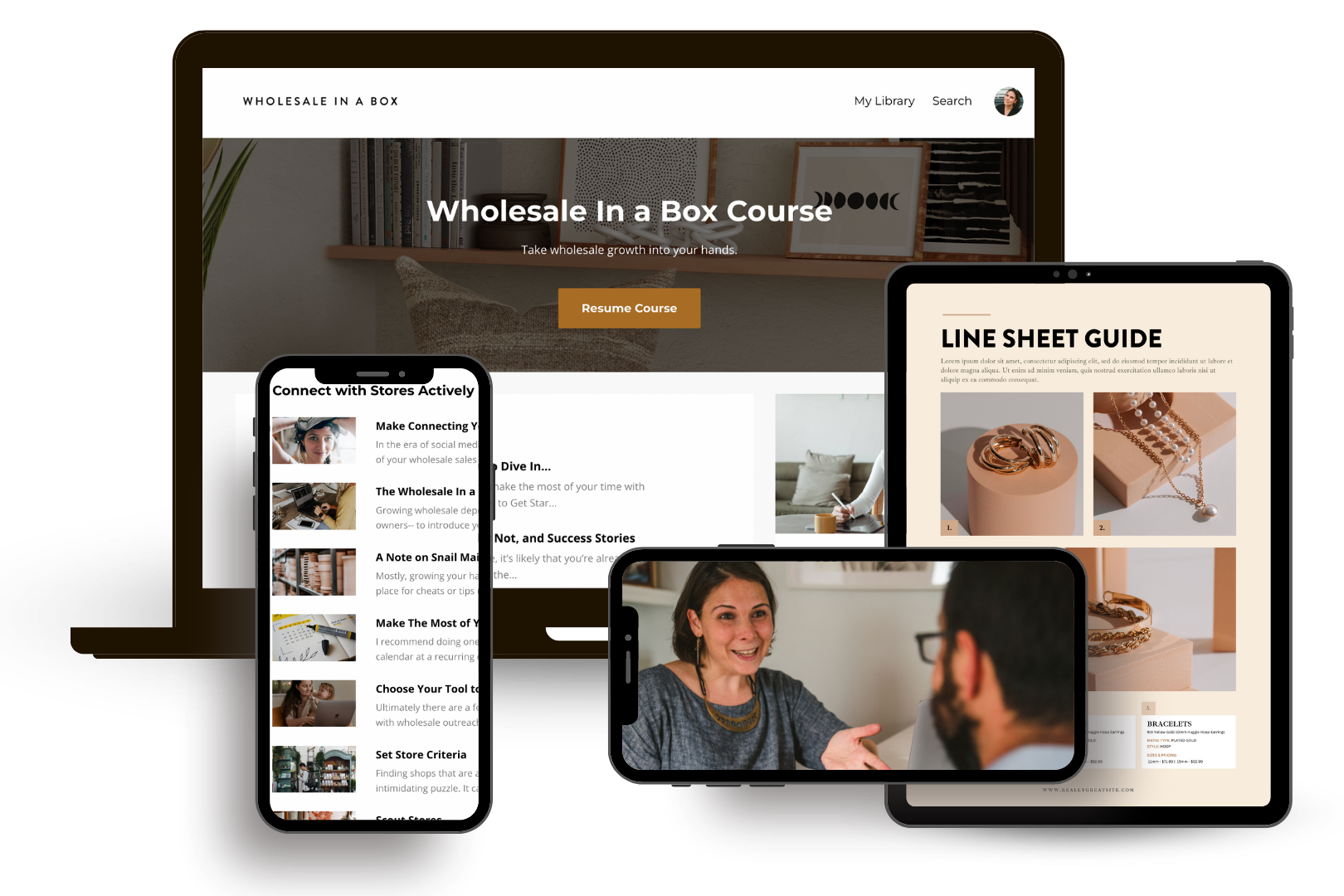
Wholesale In a Box
Our beloved comprehensive course and coaching is your all-in-one way to grow wholesale fast, steady, and long-term. Learn more here.
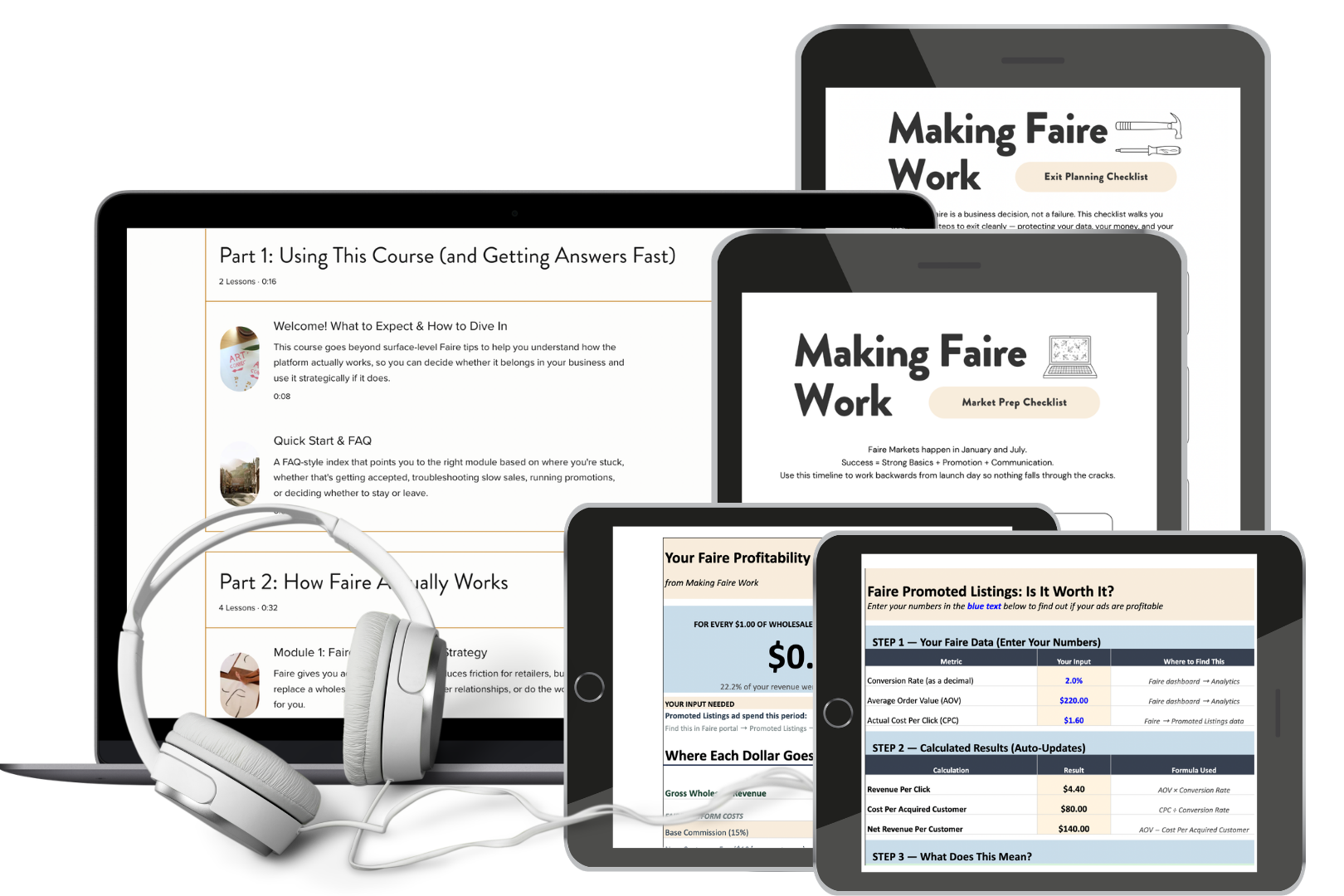
Making Faire Work
Faire has changed… so our team at Wholesale In a Box went on a deep dive into what Faire actually is today and what it takes to succeed on it. Check out the course here.

Getting Started With Wholesale
A free 4-part email course covering the basics of how wholesale works, keys for success, whether it’s right for you, and how to get started. Sign up here.

The Wholesale Reset
Our free email course for more advanced brands — we’ll help you reset your approach to wholesale and take concrete steps forward to change your results. Sign up here.