
Why Retailers Aren't Finding Your Faire Listings
When your Faire sales feel flat (or are declining for indecipherable reasons!), the instinct is to assume buyers are seeing your work and passing. You feel like the kid in the cafeteria at the empty lunch table while everyone walks by.
That assumption is understandable, and it's also, in a lot of cases, wrong. The more likely scenario is that the right buyers aren't seeing your listings at all. It has nothing to do with how good your work is, and more to do with -- you guessed it -- the algorithm. Something about how you're showing up on the platform isn't giving Faire's algorithm what it needs to put you in front of them.

There are a few things that feed into that — your seller performance metrics among them — but listings are where most brands have the most control and leverage, and they're the foundation everything else builds on.
So in this article we’re going to look at:
Why your listings matter more than you think
How to write great product titles
What to put in your product descriptions
How to optimize your Faire photos
How catalog size affects your visibility
Why tags and categories matter
How to keep your catalog fresh
The role of accuracy in listings
Why Your Listings Matter More Than You Think in Faire’s Algorithm
When a retailer opens Faire, they aren't browsing a neutral catalog. They're being served a curated version of it — one that Faire's algorithm has assembled based on criteria including:
What that specific buyer has searched for
What they've ordered before, what's trending in their region and category
Which brands seem like a match for the kind of shop they run
Which sellers have the performance metrics to back up the promise of a good transaction.
What this means practically is that you aren't competing for generic visibility on Faire. You're competing to be the right answer for a specific buyer at a specific moment. And listings sit at the center of that in more than one way.
Your listings determine whether you show up in a search result at all — the algorithm reads your titles, descriptions, tags, and categories to decide whether your products belong in front of a given buyer. Once you surface, your listings determine whether that buyer clicks. Once they click, your listings determine whether they convert to an order. Each of those is a distinct job, and weak listings can fail at any one of them without you ever knowing which one is the problem.
Faire uses your track record across all three — how often you surface, how often you get clicked, how often you convert — as ongoing input into how much it surfaces you going forward. Strong listings build on themselves over time. Weak ones create drag that's easy to miss until the gap between where you are and where you could be has gotten pretty wide.
That's why listings aren't a setup task you complete once and move on from. Listings are absolutely foundational and crucial to your success on Faire, and they’re in your hands.
The Real Reason Your Faire Listings Aren't Getting Traction
Most makers who aren't getting traction on Faire assume the platform isn't working for their category, or that their price point is the issue, or that competition has gotten too thick to break through. And sometimes those things are factors. But before you write off the platform, it's worth asking a more basic question: are my listings actually set up to work for Faire’s algorithm?
Faire has published its own data on the cost of weak listings, and the numbers are somehow both panic-inducing and oddly empowering. Unclear images alone lead to a 21% drop in conversion. Capitalization errors — something as simple as inconsistent or all-lowercase product names — lead to a 23% drop. Those numbers don’t even reflect more substantive changes like to titles or descriptions.
Beyond conversion, weak listings affect whether you show up at all. If your product titles are vague or branded in ways that only make sense to someone who already knows your line, you're invisible to the buyers searching for what you actually make. If your descriptions are thin, the algorithm has less to work with when it's trying to match your products to the right retailer. If your photos are unclear or cluttered, buyers who do find you won't click — and low click-through rates tell the algorithm your listings aren't worth surfacing.
The good news is that all of it is fixable and overall straightforward.
4 Things About Faire Most Makers Get Wrong
Get your free guide & discover:
🔓 What Faire actually requires to succeed (and what most sellers never find out)
🔓 The real limits of the platform — before they cost you time and money
🔓 Exactly how to decide if Faire is worth it for your specific business
How to Write Faire Product Titles That Show Up in Search
Your product title is the single most direct input you have into Faire's search matching. It's the first thing the algorithm reads when deciding whether your product belongs in a set of search results, and it's the first thing a buyer reads when deciding whether to click.
Both of those jobs are hurt by titles that lead with branding instead of description. If you name a mug after a character or a theme from your personal creative world, a buyer searching for "octopus mug" or "nautical ceramic" will never encounter it. The algorithm has no way to make that connection, because the words a buyer would use to find the product don't appear in the title.
Faire recommends keeping product titles between 35 and 50 characters and leading with the most descriptive keywords — material, style, color, format. The goal is to be able to read a title and know exactly what the product is without looking at the photo. As Faire's own team has put it, many brands default to whatever they use on their B2C site, which often means a title like "The Cassidy Necklace" instead of something like "Gold Chain Link Necklace, 18-inch with Charm." The first title tells a buyer nothing but the second one tells them precisely what’s in the listing.
And of course, the obvious ones… Spell-check your titles. Avoid all-lowercase and all-uppercase. And never use a SKU as a product name.
What to Put in Your Faire Product Descriptions
A product description on Faire is doing two jobs at once. It's feeding the algorithm additional keyword context it can use to match your products to the right searches, and it's giving a retailer enough information to feel confident placing an order for something they've never held in their hands.
The mistake most makers make is writing a description for someone who already wants the product — leading with aesthetic language or personal backstory instead of the practical information a buyer needs to make a business decision. Retailers aren't shopping for themselves. They're evaluating whether their customers will buy this, when they'll buy it, and how it will perform on the shelf. Your description should make those answers easy.
A strong Faire product description covers what the product is and what makes it distinctive, why customers tend to buy it and for what occasions or contexts, how it performs as a retail item (gift? impulse buy? seasonal staple?), and the practical details: materials, dimensions, weight, care instructions, country of origin. That last category matters more than many makers expect — retailers who can't quickly get to dimensions or care instructions will often move on rather than ask.
Many retailers arrive at your listing directly from a Google search rather than from inside Faire. That means the first 150 or so characters of your description may function as a meta description — the text a buyer reads before they even click through to your page. Make sure those opening sentences lead with the core value of the product and a clear description of what it is, not with a warm-up sentence or a tagline.
What Makes Strong Faire Product Photos
Photos are your most important conversion tool on Faire, and Faire's own data backs that up — unclear or cluttered images are one of the single biggest drivers of conversion loss on the platform. A 21% drop in conversion from unclear images alone is a significant drag on your performance, and it's easily avoidable.
Faire recommends square, high-resolution images — at least 1825 x 1825 pixels — and a minimum of four per product. That minimum should include a clean shot on a white or neutral background (this is typically your main image and should make immediately clear what the product is), a lifestyle image showing the product in context or in use, a detail or texture shot, and an additional angle or variation. Beyond those four, strong additions include the product in its packaging, lifestyle photos showing it in a retail setting, and anything that helps a retailer visualize it on their shelves alongside other products.
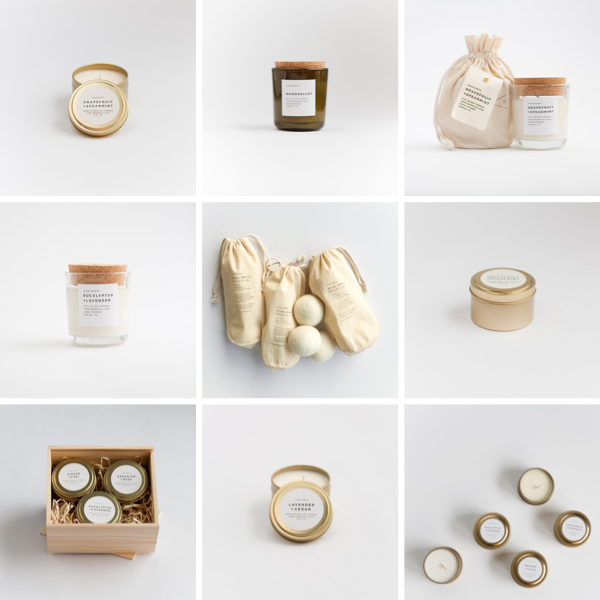
Scale is one of the most overlooked details in product photography. If a buyer can't tell how big something is from your photos, that's friction standing between them and the order button — and retailers won't always ask. If size is ambiguous in your images, find a way to show it.
For your primary image, while a clean white-background shot is Faire's standard recommendation, a lifestyle image can work well as your primary when it clearly shows scale and context. What you want to avoid is a primary image that gets someone to click but then leaves them confused about what they're actually looking at. Clarity is what converts, whatever the background.
How Many Products Do You Need on Faire to Get Noticed?
This is one area where the reality is not as I wish it was. So many wonderful indie brands and makers have tiny, beloved catalogs of goods. But Faire is consistent on this point: brands with more listings do better. More products mean more search queries you can potentially match, more opportunities to appear in browse results, and more options for a retailer to fill a minimum order once they've found you and decided they like what you make.
This doesn't mean you need to list everything you've ever made all at once. But if you've been holding back products because you're waiting until they feel "ready," or because you're worried about managing too many SKUs, it's worth reconsidering. Incomplete catalogs cost you visibility in ways that add up over time. List what you have, list it well, and build from there.
Are Your Faire Tags and Categories Hurting Your Visibility?
Before a retailer can fall in love with your work, they have to find it — and tags and categories are a significant part of how that happens.
Every product on Faire needs a designated product type. Products without one don't appear in your brand shop or in search results at all, which means a product without a product type is effectively invisible regardless of how strong the title and description are. Faire's category system has three tiers, and assigning all three accurately is what allows your products to surface when retailers are browsing by category rather than searching by keyword.
Faire also offers brand value tags — Handmade, Not on Amazon, Eco-Friendly, and others — that are worth taking seriously. These aren't just labels. Retailers actively filter by them, and having the right tags can land your shop in Faire's "Featured" tab, which carries its own visibility benefits. If your work qualifies for these tags, use them. The buyers who filter by "Handmade" are also, generally, the buyers who are most interested in building long-term relationships with independent makers — which makes them more likely to become your best wholesale accounts.
Why Faire Rewards Brands That Keep Their Catalog Fresh
Getting your listings right at launch is the foundation. Keeping them fresh is what sustains visibility over time — and the gap between those two things is where a lot of brands lose ground.
Faire's own data shows that brands adding new products are ranked 20% higher in the marketplace. New additions also surface your brand on the "New Products" page within your category, which is additional organic visibility you don't have to pay for. The platform recommends adding new products at least once a quarter, not necessarily to constantly expand your line, but because fresh activity signals to the algorithm that you're an engaged, active seller rather than one that set up a shop and walked away.
The Faire team has been direct about this in conversations with us:
"When brands get too comfortable or too passive, that's when we start to see sales decline. Retailers love newness and freshness above all in terms of products. So Faire loves newness and freshness."
If your core lineup is stable, there are still practical ways to generate that freshness signal without dramatically expanding your catalog. Seasonal bundles — grouping existing products into a "Mother's Day" collection or a "Holiday Gift" assortment — count as new listings. Releasing colorway or variant additions over time rather than all at once gives you multiple moments of freshness from work you've already done. Limited edition products create novelty without adding permanent SKUs to manage long-term.
Beyond new products, regularly revisiting existing listings — refreshing photos, updating titles and tags, retiring products that are no longer performing — also contributes to the freshness signal and keeps your catalog working as hard as possible for you.
How to Keep Your Listings Accurate to Protect Your Performance
Freshness and discoverability matter, but they can be undermined by a catalog that's drifted out of alignment with how your business actually operates today. Accuracy is the less glamorous side of listing maintenance, and it's the side most makers overlook until it starts costing them.
Out-of-stock items left up without updated inventory levels create cancellations. Cancellations create performance signals you don't want — and once your customer service metrics pass certain thresholds, recovering your visibility becomes genuinely difficult. Products you're no longer making should be unpublished rather than left up with zero inventory. Your lead time, shipping terms, and return policy should reflect how your business runs right now, not how it ran when you first set up your account two years ago.
Managing a perfect catalog at all times is just not realistic for most independent makers. The goal is a sustainable system: a regular practice of reviewing what's live, updating what's drifted, and making sure what a retailer sees when they land on your page is an accurate picture of what you actually offer.
When It Comes to Faire, Everything Starts With Your Listings.
Listings aren't the most glamorous part of running a wholesale business. They don't have the same satisfaction as making the work, or the excitement of landing a new account. But they are one of the highest-leverage things you can do — because they affect whether you get found, whether you get clicked, and whether you convert, all at once. Most makers set them up once and move on. The ones who treat them as something worth returning to are those that see the difference over time.
Level Up Your LIstings
If you want to go deeper on any of this, Making Faire Work covers listings in much more detail — including a more comprehensive audit checklist you can work through product by product. Learn more about the course here.
Your Faire Listing Checklist
Here's a quick checklist to run against your listings — feel free to bookmark it and come back to it whenever you're adding new products or doing a catalog refresh.
Titles
Leads with descriptive keywords (material, style, color, format) — not your brand name or product nickname
Between 35–50 characters
Properly capitalized, spell-checked, no SKUs
Descriptions
Opens with a clear description of the product (not a tagline or warm-up sentence)
Covers what it is, why customers buy it, and how it performs at retail
Includes all practical details: materials, dimensions, weight, care instructions, country of origin
Photos
At least 4 images per product, minimum 1825 x 1825 px
Includes: clean neutral/white background shot, lifestyle image, detail shot, additional angle
Scale is clear — a buyer can tell how big the product is without asking
Categories & Tags
Every product has a product type assigned (products without one don't appear in search)
All three category tiers filled in accurately
Applicable brand value tags applied (Handmade, Not on Amazon, Eco-Friendly, etc.)
Catalog Size & Freshness
No products being held back because they don't feel "ready"
New products added at least once a quarter
Seasonal bundles or variant releases used to generate freshness signals without expanding your permanent catalog
Accuracy
Out-of-stock items updated or unpublished
Products you're no longer making are unpublished
Lead times, shipping terms, and return policy reflect how your business runs now